
Custom gummy packaging for a cannabis or hemp brand is usually a child-resistant zipper pouch (flat for single serve, stand-up for multi-serve), a CR-lidded jar for counts, or a carton with an insert. It is opaque where the state requires it, with the 16 CFR 1700.20 report for the closure. Our cannabis edibles packaging runs start at 5,000 per design.
Quick answers
Format. A CR zipper pouch (flat for single serve, stand-up for multi-serve), a CR-lidded jar for counts, or a carton with a certified closure and insert. We make all four.
Child resistance. The zipper is the tested part. Ask for the CPSC 16 CFR 1700.20 test report before you order.
Opaque or window. California's Department of Cannabis Control requires edibles packaging to be opaque. Check your own state before you spec a window.
Minimum. 5,000 units per design.
Lead time and price. Most runs ship in 20 business days after proof approval, die cut mylar in 14. Printed mylar bags run $0.35 to $0.95 per unit; jars and cartons are quoted individually.
The problem: gummies are the edible regulators watch most closely
A gummy looks like candy. That is the problem, and it shows up on two fronts.
The first is regulatory. On July 5, 2023, the FDA and FTC issued warning letters to six companies for illegally selling copycat food products containing delta-8 THC that could be mistaken for chips, cookies, candy, gummies or other snack foods. In California, 4 CCR section 17300 prohibits any cannabis product the Department of Cannabis Control determines is attractive to children, any product easily confused with ordinary foods that do not contain cannabis, and any product in, or imprinted with, the shape of a human being, animal, insect or fruit. That is a product rule, not a packaging rule, but the gummy and the pack face the test together. A candy-style pouch with a clear window showing bear-shaped gummies fails twice, and the window is the trap: general gummy packaging suppliers, the ones serving candy and supplement brands, sell it as a standard menu item.
The second front is physical. Gummies sweat, stick together and harden when the barrier is wrong, and a thin film that suits fast-moving flower is not the right spec for an edible that sits on a shelf for months.
What a gummy pack has to do
The clearest public checklist is the California Department of Cannabis Control's packaging guidance (revised March 28, 2023). It asks for packaging that is:
Tamper evident. Sealed so a consumer can tell if it has been opened.
Child-resistant. Tested, not styled.
Resealable for any package with more than one serving.
Opaque for edibles. Consumers cannot see the product through the packaging. Cannabis beverages may use clear or coloured glass; a gummy pouch or jar may not.
Not an imitation of packaging used for products typically marketed to children or persons under 21.
That is California. Rules differ by state, so confirm the list with your own state cannabis regulator before anything goes to print; our overview of cannabis packaging regulations covers where states diverge. Hemp gummies cross state lines, so more than one state's labelling rules can apply to the same bag. Leave label panel space at the design stage.
Child-resistant and tamper-evident are different features: tested so young children cannot open it, versus obvious if it has been opened.
Gummy packaging formats compared
Common on the market: stand-up, lay-flat and resealable zipper pouches, roll stock film for form-fill-seal lines, in barrier laminate, plain plastic or kraft-faced versions. For a licensed gummy, the choice narrows to four finished formats, all of which we make, plus one option.
Single-serve flat pouch (we make these). A small three-side-seal pouch for a 10 mg single or a sampler. Child resistance comes from a small certified CR zipper or, in California, from a heat-sealed single-serve pouch of 4 mil film (next section). Opaque for a licensed edible. One serving, so no resealable requirement under the California list.
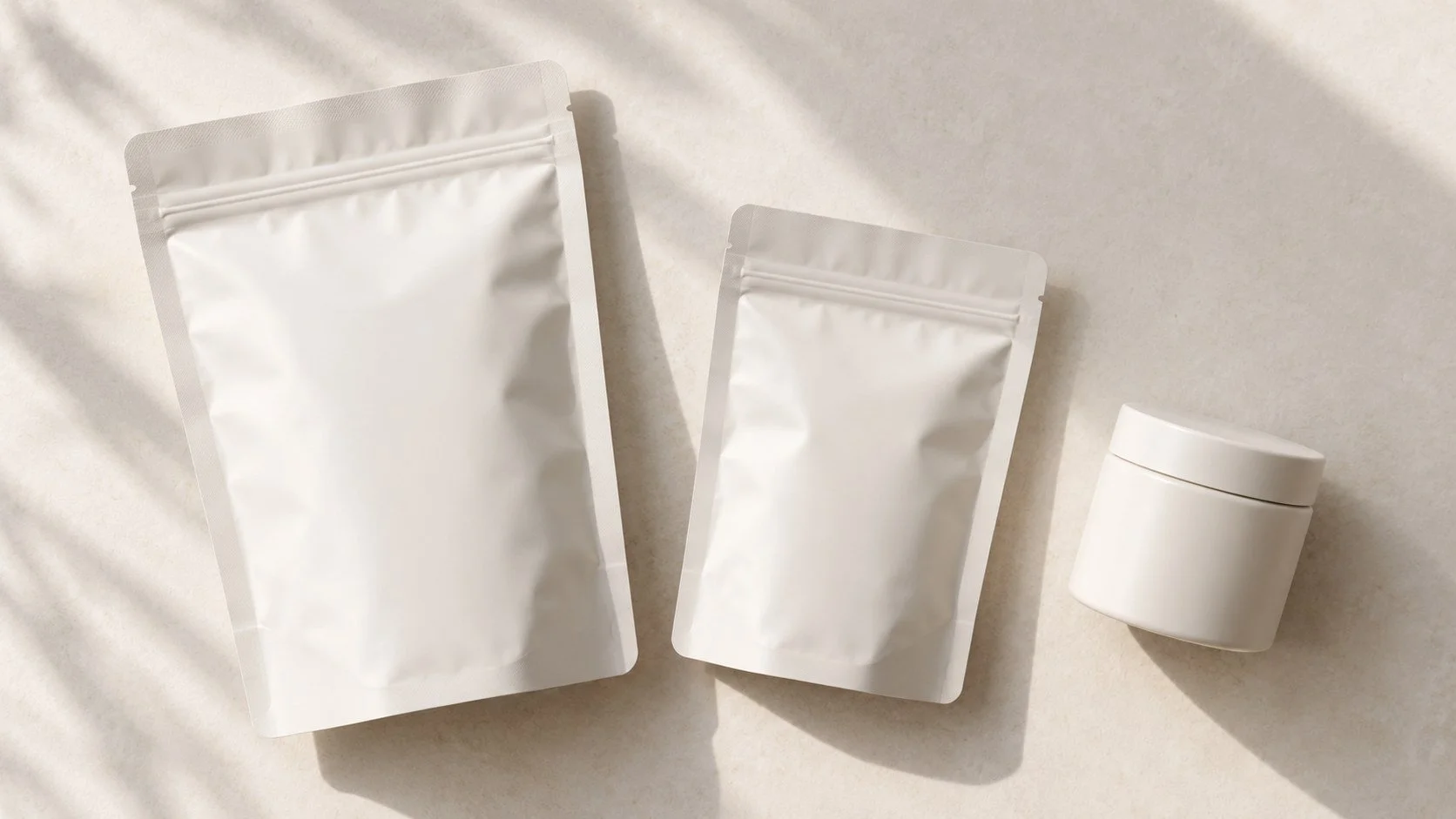
Multi-serve CR stand-up pouch (we make these). The standard 100 mg pack. The certified CR zipper carries the child-resistant rating; the heat seal above it is the tamper-evident part. Resealable by design, opaque print rather than a window. Sized to what goes in, from single serve up to 100 mg packs.
CR-lidded jar (we make these). For 10 and 20 counts, and for mints, tablets and small pieces. 1 oz to 4 oz, labelled or printed. The lid carries the child resistance. Specify an opaque jar where your state requires it.
Carton with CR closure and paperboard insert (we make these). A folding carton with a certified push-pull or squeeze closure and a paperboard insert cut to the product, full colour, matte or gloss, on food-safe board and inks, for premium or gift packs. Some states accept a CR carton with non-CR items inside, others want the primary container to be CR, so check before you commit.
Die cut pouch shape (an option on the pouches above). Any closed outline, with the zipper running straight across the top, which sets a minimum width at the mouth. Thin points and deep inner corners are rounded slightly because they weaken the seal edge. Keep the outline away from fruit, animal, insect or human shapes given California's product rule.
Single-serve or multi-serve: decide it before artwork
This decision sets the format, the closure and the size. Under California 4 CCR section 17304, an edible cannabis product may not contain more than 10 mg THC per serving and 100 mg THC per package. Under 4 CCR section 17412, the package must be child-resistant for the life of the product, with two carve-outs that matter for gummies:
A package with more than a single serving is not required to be child-resistant if each individual serving inside is in child-resistant packaging.
For a single-serving product, plastic packaging at least 4 mils thick, heat-sealed without an easy-open tab, dimple, corner or flap, counts as child-resistant, as does any package certified under 16 CFR 1700.15(b)(1).
So a California brand has three workable routes: a multi-serve stand-up pouch with a certified CR zipper; a non-CR multi-serve pack holding individually CR-packed singles; or heat-sealed 4 mil singles. For resealable singles we offer small CR zipper pouches or peel-and-reseal labels, depending on the product. The 10 mg and 100 mg caps are California's, not a national rule, so confirm your state's before the artwork locks in a count.
The certificate belongs to the zipper
A pouch is not child-resistant. Its closure is. On a CR mylar bag, the zipper is the tested part and the heat seal above it is the tamper-evident part. A standard zipper bag is not child-resistant.
The federal test procedure is CPSC 16 CFR 1700.20. It uses a panel of children aged 42 to 51 months and a senior adult panel aged 50 to 70. Under 16 CFR 1700.15(b), the package must show child-resistant effectiveness of not less than 85 percent without a demonstration and not less than 80 percent after one, and senior adult use effectiveness of not less than 90 percent.
A closure that passes comes with a test report. The check from our child-resistant packaging page applies here: certified, or just CR-style? Ask for the test report. If the answer is a brochure, it isn't certified. Every certified format we make comes with its CPSC 16 CFR 1700.20 test documentation, sent on request, before you order if you like.
CR is not airtight. A CR closure keeps children out but does not always keep air out, so a seal is a separate spec. If your plan relies on a CR jar lid rather than a zipper, see child-resistant caps and closures.
Film, barrier and finish
The pouches on our custom mylar bags page are laminates with three layers: a polyester outer for print and strength, a metallised layer that blocks light and oxygen, and a food-grade polyethylene inner that heat seals. Thickness is measured in mil. Thinner film is cheaper and fine for flower that moves quickly; thicker film keeps edibles fresher for longer, so a gummy pouch is specced heavier than a flower bag.
Pouches take full-bleed print up to 8 colours, in matte, gloss or soft-touch. Clear window or opaque are both available; for a licensed edible the answer is opaque. A resealable zipper comes on every size, and a certified CR zipper is available on request. For a shaped pouch, die cut mylar bags take any closed outline, with a physical proof of the cut shape before the run.
Minimums, price band and what to send for a quote
Minimum. 5,000 units per design for custom printed bags and for edibles packaging, cartons included. The minimum is per SKU, so two flavours with different artwork are two minimums. Plain stock bags start lower, sold by the case, quoted alongside.
Price band. Printed mylar bags run $0.35 to $0.95 per unit at a minimum of 5,000 per design. Size, finish, colour count, die cut shape and a certified CR zipper decide which end of the range you land on; quantity moves you within it. A small three-side-seal bag in one colour sits at the bottom; a pound-size, soft-touch matte, die cut, CR-zipper bag sits at the top. Jars and cartons are quoted individually. The published ranges are on our pricing page.
Quantity. Running more units lowers the per-unit price because tooling, plate setup and press makeready spread across a longer run. The jump from the minimum to double the minimum is usually the largest single saving.
Lead time. Most runs ship in 20 business days after proof approval; die cut mylar in 14. Prices are ex-works, made in China, with freight and import duty quoted with the order. Sea freight is the default and is what the lead times assume.
Quote turnaround. Two business days, with indicative pricing, the real minimum and a production timeline. Have these ready:
The product, serving size and count per package (for example 10 mg by 10)
The state or states you sell in, and whether CR certification is required there
Format: flat pouch, stand-up pouch, CR jar, carton, or more than one
Finish, and whether you want a die cut shape
Quantity per SKU, even as a range
Where the artwork is at: final files, a brief, or nothing yet
Send it through our quote page or email hello@firstrunsupply.com.
FAQ
What is the minimum order for custom gummy packaging?
5,000 units per design for custom printed bags and for edibles packaging. The minimum is per SKU, so each pouch with its own artwork carries its own minimum.
Does gummy packaging have to be child-resistant?
That is set by your state cannabis regulator. In California, 4 CCR section 17412 requires the package for an edible product to be child-resistant for the life of the product, unless each serving inside is in its own child-resistant packaging. The federal test behind a certified closure is CPSC 16 CFR 1700.20, and a certified pouch comes with a test report.
Can gummy packaging have a clear window?
Not for an edible sold in California. The Department of Cannabis Control's checklist requires edibles packaging to be opaque, with cannabis beverages as the exception. Other states set their own rules, so check with your regulator first.
How much does custom gummy packaging cost?
Printed mylar bags run $0.35 to $0.95 per unit at a minimum of 5,000 per design. A certified CR zipper, soft-touch finish, a die cut shape and a larger size push a pouch toward the top of that band. Jars and cartons are quoted individually.
How long does a gummy packaging run take?
Pricing comes back within two business days. After proof approval, most runs ship in 20 business days and die cut mylar in 14. Freight is on top, with sea freight as the default.
Send us the product, the serving size and count, your state and your quantity per SKU. Request a quote and we come back within two business days.
