
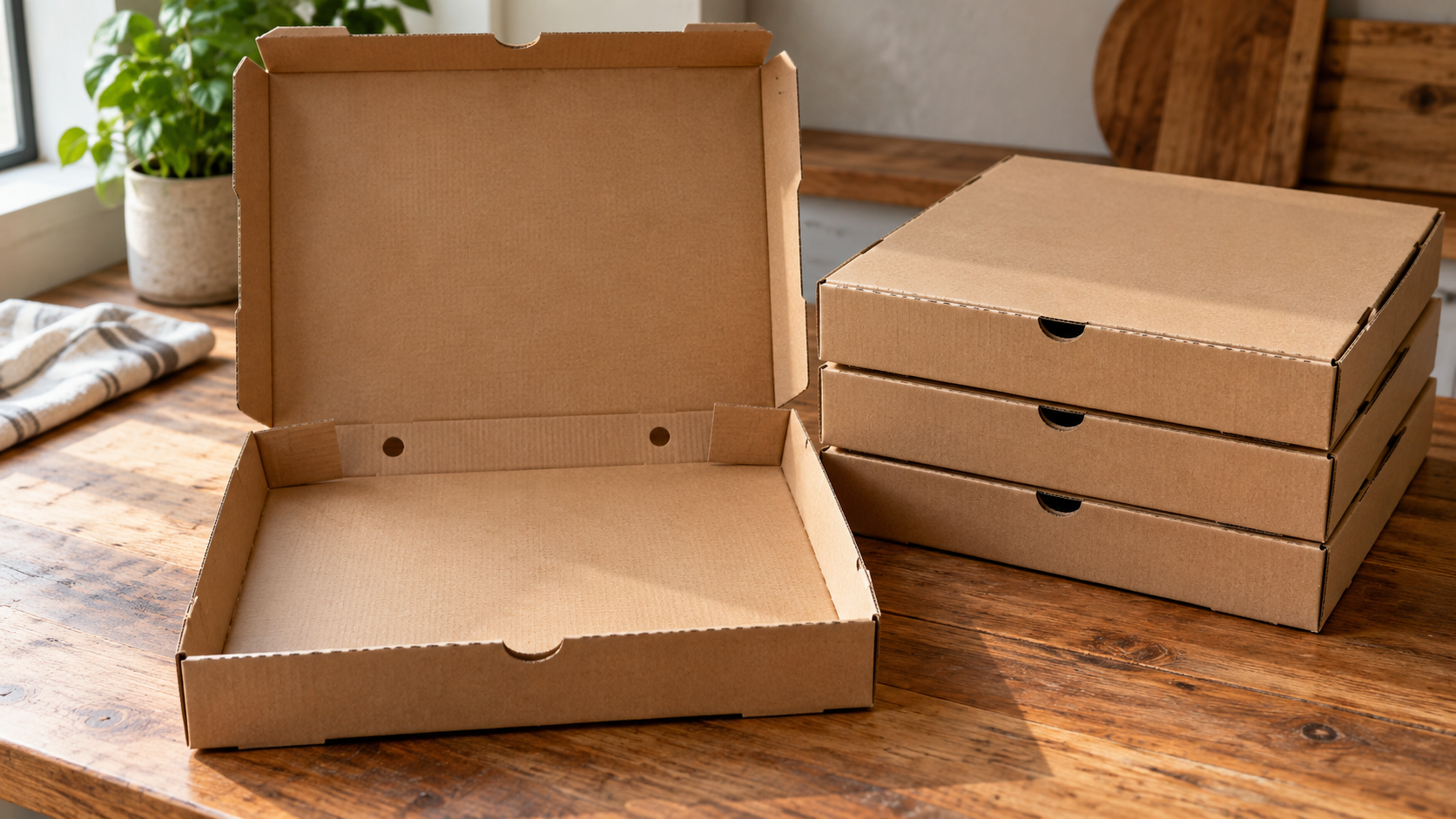
Custom pizza boxes are E-flute corrugated boxes sized to the pie, which means 10, 12, 14 or 16 inch with us. Each one has steam vents as standard, carries your logo in one or two colour flexo on a kraft or white exterior, and is ordered per size, because every size is its own run.
Quick answers
Sizes: 10, 12, 14 and 16 inch. Each size is a separate order.
Board: E-flute corrugated, which keeps a wide, flat box stiff enough to carry level and gives the pie some insulation on the way home.
Print: one or two colour flexo on a kraft or white exterior. Bold artwork works best.
Minimum: 10,000 per size. Pizza boxes are the one takeout item that does not pack small.
Lead time: 6 to 8 weeks door to door by sea. Air freight is quoted on request, and reorders are faster.
The problem: the pizza box is the biggest thing you buy and the easiest to get wrong
Ask any pizzeria owner which piece of packaging causes the most trouble and the answer is usually the box. It is the largest item in the stockroom. It is bought in more sizes than anything else on the menu. And it has to do a real job: carry a hot, heavy, oily pie level, through a car ride, and arrive with the crust still crisp.
Here is where buyers get caught out:
Bulk. A pizza box is wide and flat, and it does not pack small the way most takeout items do. Storage space goes fast.
Every size is a separate order. A menu with a small, medium, large and extra large is four box orders, not one. Each size has its own die, its own run and its own minimum.
A sealed box steams the crust. Hot pizza gives off moisture. With nowhere to go, it turns a crisp base soft before the box reaches the door. Some buyers ask to remove the vents so the lid prints cleaner. That trades the product for the picture.
Fine artwork fails on corrugated. A detailed logo that looks sharp on a menu or a website can blur and fill in on fluted board. Thin lines, small type and soft gradients are the first to go.
Each of these is fixable at the spec stage. The rest of this guide walks through the decisions in the order we make them on a quote.
Pizza box sizes: order by the pie, not the menu
We make custom pizza boxes in four sizes: 10, 12, 14 and 16 inch. The size refers to the pie the box holds, so measure the pizza you actually bake, not the name on the menu. One shop's "large" is another shop's "medium", and a box that is a little too big lets the pie slide into a corner on the drive.
Two rules make sizing simpler:
Size to the real pie. Measure a few finished pizzas from a busy night and use the typical diameter, not the best case.
Count sizes carefully. Because each size is its own order with its own minimum, every size you add multiplies the total. Three sizes at 10,000 each is 30,000 boxes.
If part of your menu goes out in other formats, such as clamshells, trays or pails, our guide to takeout box styles covers those. This post stays on pizza. The full product spec sits on our custom takeout boxes page.
Board and flute
Our pizza boxes are E-flute corrugated. Corrugation is the wavy layer between two flat sheets of board, and it is what lets a wide, flat box stay rigid enough to carry level. It also traps a little air, which gives the pie some insulation between the oven and the table.
Across the market you will see two common flute choices:
E-flute is a thinner wall with a smoother face. Print detail comes out sharper, and the boxes take less storage space. This is what we make.
B-flute is a thicker wall with more crush resistance. Some other suppliers offer it. We do not, so if your operation needs B-flute, we will say so on the quote.
You also choose the exterior colour of the board:
Kraft is the natural brown board. It suits a rustic, craft or neighbourhood look.
White gives a brighter background, so a two colour logo has more contrast.
Printing a logo on corrugated
A pizza box with a logo is printed in one or two colour flexo, on kraft or white. The plates are made once and kept on file, and the method rewards simple artwork.
How to design for it:
Design bold. Corrugated board will not hold fine detail. Use solid shapes, thick lines and type that stays legible at a distance.
Treat the lid as a billboard. The whole lid is the surface people see when the box lands on a counter, a car seat or a dining table. A large logo and a short line, such as your phone number or web address, does more work than a busy pattern.
Pick your colours with the board in mind. On kraft, a dark ink reads best. On white, two colours give you room for a logo plus an accent.
Keep the vents. Vents are part of the box, not a defect in the print. Plan the artwork around them.
On food safety, our boxes ship with the factory's food-contact file under FDA 21 CFR 176, the US rule for paper and paperboard in contact with food. The inks are low-migration, and the factory supplies a declaration for each run. More on how we handle food-contact paperwork is on our custom food packaging page.
Vents, grease and getting the crust home crisp
Steam vents are standard on our pizza boxes. They let moisture out so the crust does not sit in its own steam, which is the most common reason a delivery pizza arrives soft.
Grease is the other half of the job. Pizza boxes have a moderate grease need: a lot of oil, but for a short time, with the corrugation behind it. That is a different problem from a container that holds a saucy dish for an hour.
Grease-resistant paper packaging in the US has moved away from PFAS-based treatments, and a growing list of states bans intentionally added PFAS in food packaging. First Run specifies PFAS-free barriers where food touches the board. If you want the background on what PFAS-free means and the questions to ask any supplier, read our guide to PFAS-free foodservice packaging.
Is a 10,000 per size run right for you?
This is the question most pizza box suppliers skip, because most of them sell short runs, from a single box up to a few thousand. Our boxes are made in China, at export factories that ship to the US every week, and printed to US food-contact standards. Our minimum is 10,000 per size, so the honest first step is a little arithmetic.
The volume test:
Count your sizes. Three sizes at 10,000 each is 30,000 boxes on the first order.
Find your weekly pies per size. Use your sales data, one size at a time.
Divide. At 200 pies a week of one size, 10,000 boxes lasts 50 weeks. At 100 pies a week, the same 10,000 boxes lasts 100 weeks, which is about two years.
Apply the one year rule. A size that would take more than about a year to use is a size to merge or drop. In the example above, the 200 a week size passes. The 100 a week size does not, so fold it into a neighbouring size or drop it.
Where it pays off: chains. A multi-location operator is where an import run makes the most sense. The die and plates stay on file, each location orders its own quantity of the same box, and reorders are a one-line email. Consolidating sizes across every store also helps each size clear the volume test faster.
When a local short run is the better buy. If a single shop does not come close to that volume, a short-run supplier closer to home is the better choice, and we would rather tell you that than sell you two years of boxes. We tell you honestly on the quote whether sea freight beats a US converter for your volume. And if we are not the right fit, we will say so on the first reply.
What to send for a quote
A complete request gets a faster, more accurate quote. Send us:
Sizes: which of 10, 12, 14 and 16 inch you need.
Volume: weekly or annual pies per size, so we can run the volume test with you.
Board: kraft or white exterior.
Colours: one or two.
Artwork: your logo, and whether it is final or still in progress.
Delivery city: where the boxes need to land.
Date needed: when you want the first boxes in hand.
We come back with pricing at two quantities in two business days. Freight and duty are on the quote with the unit price as a real number, so you can compare it straight against a local supplier. Plan on 6 to 8 weeks door to door by sea. Air freight is quoted on request, and reorders are faster because the die and plates already exist.
What you get once the spec is set:
One box per size across every location.
Artwork and die kept on file.
Reorders as a one-line email.
A quote that tells you honestly whether importing makes sense for your volume.
FAQ
What sizes do custom pizza boxes come in?
We make them in 10, 12, 14 and 16 inch. The size refers to the pie, so measure the pizza you bake. Each size is a separate order with its own minimum.
What is the minimum order for custom pizza boxes?
Our minimum is 10,000 per size. Pizza boxes are the one takeout item that does not pack small, which is why the minimum is higher than for our other food boxes.
Can I order custom pizza boxes with no minimum?
Not from us. Other suppliers sell short runs from one box to a few thousand. If a size would take you more than about a year to use, a local short run is likely the better buy, and our quote will tell you so.
Are custom pizza boxes food safe?
Ours ship with the factory's food-contact file under FDA 21 CFR 176 for paper and paperboard. Inks are low-migration, with a declaration for each run, and we specify PFAS-free barriers where food touches the board.
How long do custom pizza boxes take?
Plan on 6 to 8 weeks door to door by sea. Air freight is quoted on request. Reorders are faster because the die and plates are already made.
Ready to size your run? Send us your sizes and weekly pies for a quote.
